
Published 17 February 2026, updated 6 October 2026 · Written by Attorney Cem Arda Tepe, registered at Istanbul Bar
Types of Company Structures in Turkey
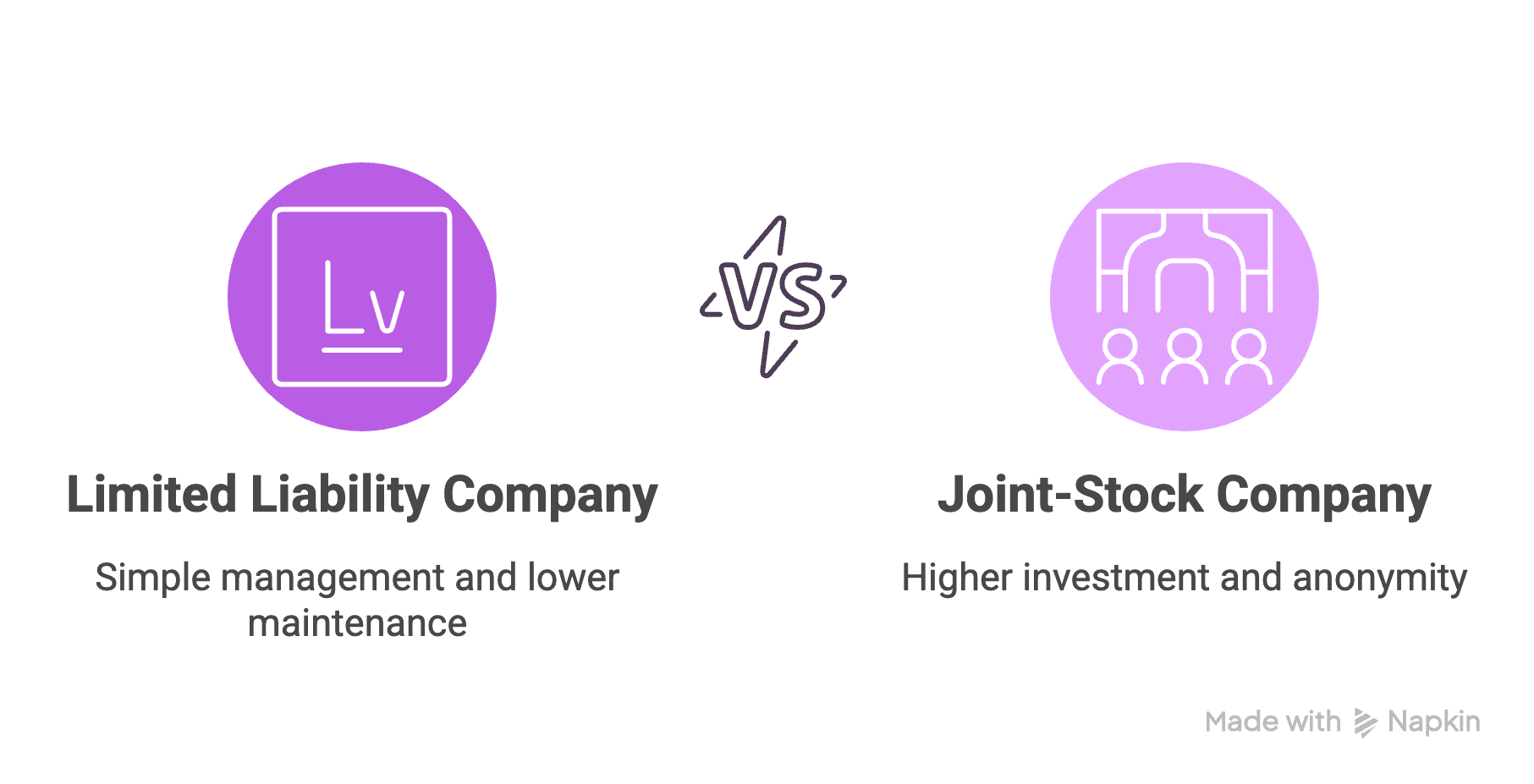
The two main types of companies in Turkey are limited liability companies and joint-stock companies (see a detailed comparison in our related article by clicking here). Other types of companies in Turkey are cooperatives, ordinary partnerships and general partnerships. All of these partnership types serve different purposes, have different structures and liabilities for partners and managers. The most relevant types for foreign individuals are the joint-stock company and the limited liability company:
An ordinary partnership means the shareholders are not protected from the company’s liabilities and debts. There is no legal shell that will shield the partners from any unpaid liabilities. One could reasonably argue that this is not a corporate structure. The rules on establishing such a partnership are not strict. For foreigners, this type of company is not a practical option, as it does not provide the tax and legal structures required for an established business.
The general partnership and the cooperative partnership company structures serve very specific purposes and are no longer popular options in Turkey. For example, in September 2024, a total of 10,491 companies were established in Turkey, comprising 1,168 Joint Stock Companies (Anonim), 9,072 Limited Liability Companies, 3 Collective Companies, and 248 Cooperatives1.
Should You Incorporate as a Joint-Stock Company or Limited Liability Company in Turkey?
The most common type of company that is established by foreigners in Turkey is a limited liability company. A limited liability company is recommended for foreigners due to its ease of establishment, a relatively simple management structure, and lower maintenance costs. The joint-stock company is a more complex form of company formation that we recommend only for specific long-term business goals, as it carries greater financial and managerial burdens.
The joint-stock company will enable your company to list on the stock exchange and engage in sophisticated crowdfunding and venture capital transactions. Furthermore, the joint-stock company offers relative anonymity, though with certain limitations.
Another type of company in Turkey worth mentioning is the holding company, but, once again, these are highly specialised structures and are only beneficial in special cases. The main feature of holding companies is the tax benefits when investing in other companies and capital market instruments. Holding companies are designed to serve as the parent company of numerous subsidiaries.
Minimum Capital Requirements for Company Formation in Turkey (2026 Update)
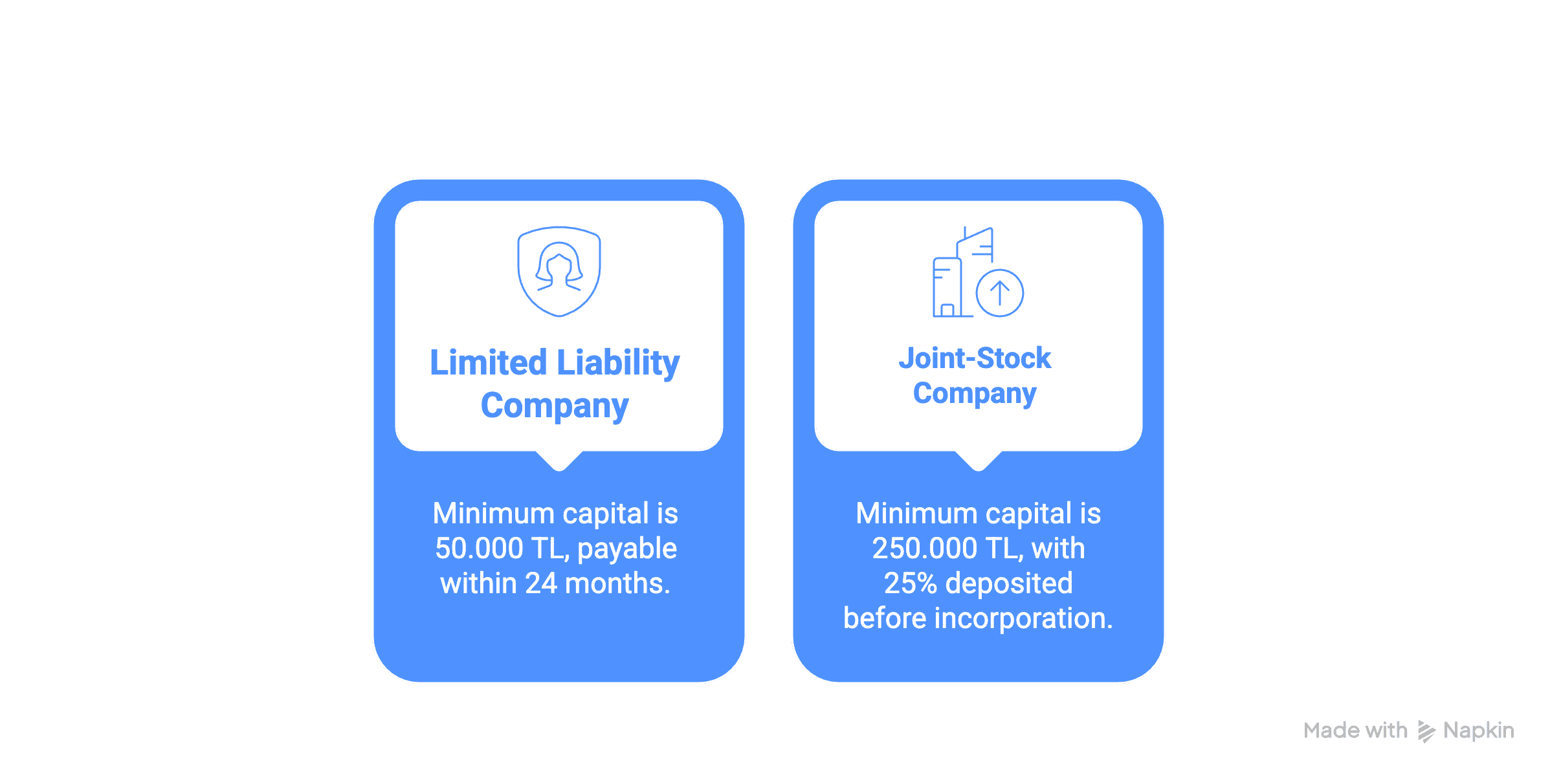
The minimum capital requirement for a limited liability company in Turkey is 50.000 TL, payable within 24 months of incorporation. The minimum capital requirement for joint-stock companies is 250.000 TL, pursuant to the presidential decree published in the Official Gazette dated 24 November 2023. 25% of this amount must be deposited and blocked in a bank account before incorporation. The 25% rule applies to joint-stock companies and is a significant difference from limited liability companies. Depending on your business needs, a limited liability company may be more appropriate if you want to avoid an advance deposit.
Although the minimum capital requirement for limited liability companies is much lower than that of joint-stock companies, we recommend that our clients set a higher capital amount in the incorporation documents to enhance their credibility with banks and other institutions and to support their business operations. Please also note that certain tenders and other processes may require higher capital amounts or request bank-required guarantee letters for specific cash amounts. For advice on the specific capital amounts your company may need to achieve its business goals in Turkey, please contact us.
Can Foreigners Establish Companies in Turkey, and Are There Any Special Requirements?
Foreigners can freely establish companies in Turkey without any restrictions. However, the most important consideration for a foreign company’s incorporation in Turkey arises after incorporation. Foreigners should be especially diligent when opening a company account after incorporation, as Turkish banks’ Know Your Customer policies, public or private, are very strict. This has been a growing trend in recent years, given the turbulent international atmosphere and Turkey’s unique geopolitical position. That is why we offer tailored consulting in this area, tailored to your business needs. Our hands-on experience and understanding of your business goals help us provide the right type of advice to our clients.
Our firm has experience working with foreign businesses seeking to establish operations in various sectors in Turkey, including e-commerce, fintech, aviation, logistics, and international trade. Furthermore, foreign entrepreneurs or established businesses may need different partnership structures for their new venture. We can ensure the right structure and approach are in place for this essential first step in entering a new market.
A foreigner can also apply for a work permit after incorporating a company in Turkey. To be eligible for a work permit in Turkey through becoming a shareholder in a company, the company must either demonstrate that its annual turnover or exports exceed the threshold set by the Employment and Social Security Ministry. Alternatively, foreign partners can hire a certain number of Turkish citizens through the company to be eligible for a Turkish work permit. Finally, it is possible to obtain a work permit directly without any further requirements if a shareholder holds 100.000 USD in share capital in a Turkish company. The rules for Turkish work permit through ownership of company shares can be found here.
Can a Foreigner Set Up a Company in Turkey Remotely?
Yes, foreigners can set up a company in Turkey remotely. Required documents can be sent to Turkey, and representatives authorised under a power of attorney can complete the company incorporation steps on behalf of the foreigner who is abroad. Every step of the process can be carried out by documents sent from abroad.
Reasons for Foreigners to Invest in Turkey
Recent trends in international relations have led to a shift in trade policies worldwide. Turkey is in an advantageous position, close to the West, while maintaining close relations with the rest of the world. This makes Turkey an attractive logistical base with advantageous customs tax. Furthermore, Turkey has developed manufacturing sectors and a highly skilled, young workforce. That is why Turkey remains an attractive choice for businesses looking to expand, avoid missing opportunities, or reach new regions where they are not yet established.
The net minimum wage in Turkey is 640 USD as of 2026. The labour force is highly skilled, and the country offers many opportunities, including free zones, technoparks, and access to European markets with customs duty exemptions.
Technoparks in Turkey
Turkey offers a strategic advantage to investors through its specialised university-based technopark zones. Technoparks provide office space to innovative companies at no cost or at very low fees. The condition for entering these zones is to provide innovative development and research in your sector. The primary advantage of technoparks is generous tax exemptions. Companies also benefit from other advantages, such as government-paid employee insurance premiums or even state-funded salaries. We help foreign investors find the right technopark for their businesses and successfully complete their applications, thanks to our presence in the business and academic sectors across many industries, including fintech, gaming, and others.
Documents Needed for Company Formation in Turkey by Foreigners
Here is a summary of essential documents needed for company formation in Turkey by foreign shareholders.
- Copy of the passport belonging to the shareholder
- Notarised passport translation of the shareholder
- Notarised power of attorney document for incorporation
- Address registration
- Contact details
We are aware that foreign investors seeking to establish companies in Turkey have diverse business backgrounds and may prefer different structures, such as sole proprietorships or partnerships with Turkish nationals or residents. Another option is to open a liaison office or a branch company rather than establishing a new limited liability or joint-stock company. Finally, some foreign businesses may prefer to incorporate a company through an existing foreign entity. Depending on the chosen alternative routes, the required documents can vary significantly. That is why the above list aims to provide guidelines and a core set of essentials.
Please note that the required documents for the remote setup of a company with a foreign shareholder may vary. For example, if the foreign shareholder is a corporate entity, a board resolution must be issued. The board resolution should authorise a representative to act on behalf of the shareholder (pursuant to Art. 90/1-ç of Trade Registry Regulation, click to access the Regulation). The process involves a more detailed structure, but we ensure a smooth, fast incorporation for remote incorporations.
Stages of Company Formation in Turkey by Foreigners
Although the general process for company incorporation in Turkey is the same for foreigners and locals, the steps for foreign shareholders who are not nationals or residents of Turkey differ.
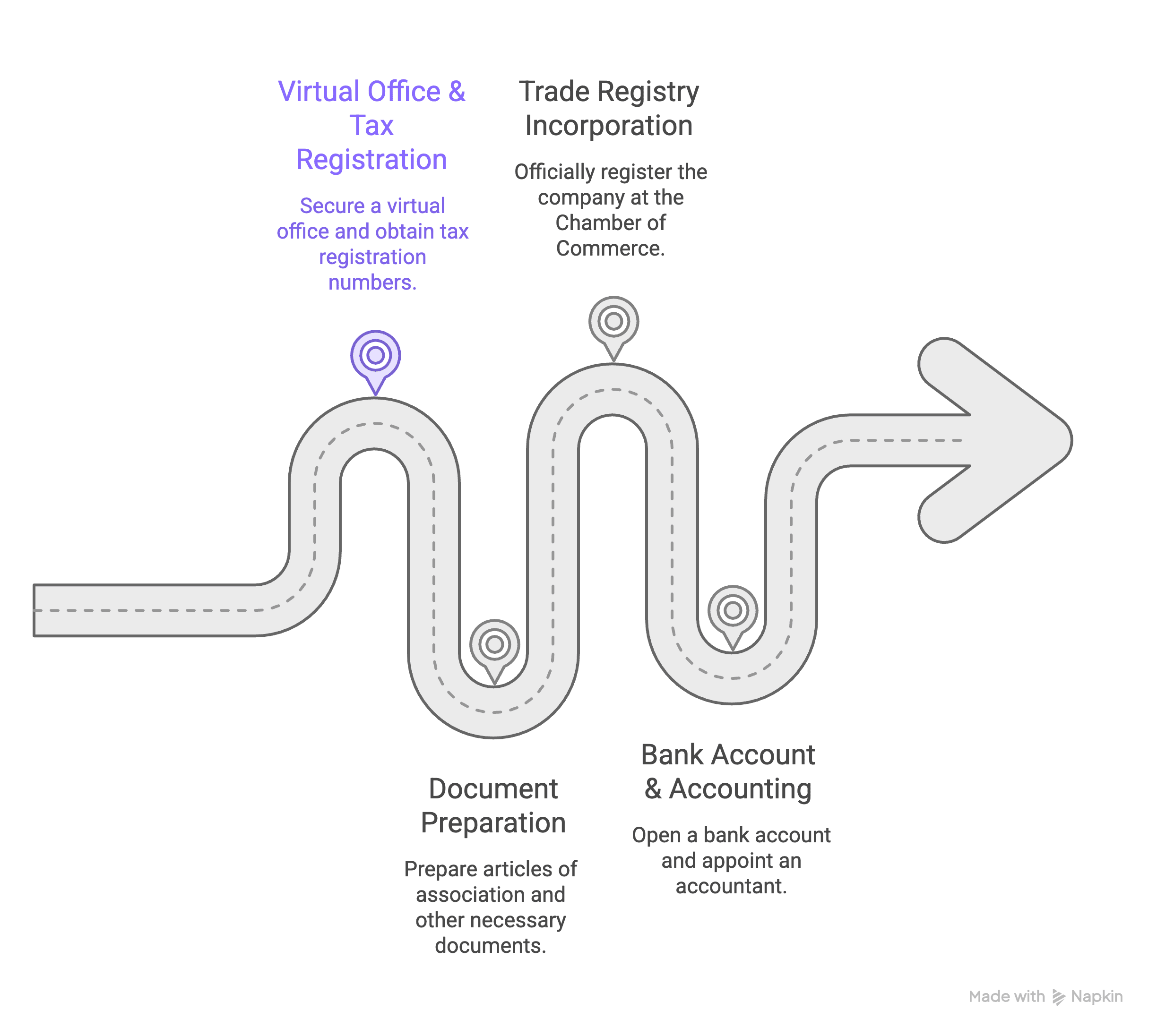
- Preparation of articles of association
- Obtaining a potential tax number
- Depositing 25% of the company’s capital (only for joint-stock companies)
- Registration of the corporate documents at the Trade Registry
- Publishing the corporate contract in the Trade Registry Gazette of Turkey
- Issuing a signature circular at the notary
- Tax and social security registrations by the company accountant
Virtual Office and Tax Identity Registration
Prior to the incorporation process described below, we advise obtaining tax registration numbers for individuals and entities related to the new legal entity being formed. In addition, the company address should be registered and later submitted to the Chamber of Commerce’s online system. The cost of virtual offices varies with location and co-working availability; a virtual office package costs around USD 310.
Articles of Association and Other Document Preparation
The essential step in company incorporation in Turkey is preparing the shareholders’ documents and related company documents. When the shareholder is a foreign individual or entity, specific documents are required. For a real-person shareholder, a notarised translation of the passport must be prepared. A foreign entity shareholder must provide trade registry documents. In both cases, a power of attorney must be issued for the authorised person to attend the incorporation appointment at the Chamber of Commerce.
This preliminary step also involves preparing the company’s articles of association. The articles of association is the fundamental document that sets out the company’s constitution. Shareholder structure, share types, and share amounts must be set out in the articles of association. Secondly, the rules on the board of directors and general assembly meetings must also be specified. For general assembly and board directors, different voting ratios and thresholds can be set to ensure valid decisions by these bodies.
An important part of the articles of association is the clause that sets out the areas in which the company will operate. Together with NACE codes that define the company’s business areas, the clause on business areas must be carefully drafted. More importantly, any future involvement in government tenders or applications for special business licences may require these clauses to include specific provisions.
The director is authorised to represent and manage the company, which is also assigned at this stage. That is why, if a third person is assigned, it must be included in the incorporation documents at this stage. The rules for appointing a director depend on whether a joint-stock company and/or a limited company is incorporated. Furthermore, whether a shareholder is an individual or a corporation also affects the required documents and procedures at this stage.
An appointment at the Chamber of Commerce is scheduled at the end of this stage.
Incorporation at the Trade Registry
The official incorporation of a Turkish company takes place at the Chamber of Commerce. The incorporation appointment is made online via the Mersis system, where all company information is submitted beforehand.
Once the company is registered with the Chamber of Commerce, its incorporation is published in the Trade Registry Gazette of Turkey. The published company incorporation includes the articles of association. Therefore, the company’s founding shareholders are listed in this gazette. Given that a joint-stock company is referred to as “an anonymous company” in Turkish, the public nature of the information in the incorporation document at this stage should be considered, regardless of the company type.
Post Incorporation: Bank Account Opening and Accounting Procedures
The company is officially incorporated, as evidenced by its listing in the trade registry gazette, and is legally alive. However, this does not mean it can act as a legal body or immediately carry out its financial duties. First, the governing body of a company is the board of directors (or the board of managers in the case of a limited liability company). For the board of directors to act on behalf of the company, its members must register their signatures with the notary. This document, produced by the notary at this stage, is called the signature circular. (Click here for more information on Board of Directors in Joint Stock Companies)
The signature circular, which shows the authorised director of the company and the director’s signature, is required to open a bank account. In addition to opening a bank account, the company must appoint an official accountant to perform its tax-related legal duties. This is mandatory under Turkish law, as in many other jurisdictions.
An important step at this stage is the official visit (“yoklama” in Turkish) by the tax officers at the company address. It is crucial to attend this official visit with the appropriate documentation to represent the company. Otherwise, your company’s legal status may be affected.

Nominee Director and Shareholder Assignment by Foreign Shareholders of Companies Formed in Turkey
Clients may prefer to appoint nominee directors or shareholders for their companies for different reasons. For example, a Turkish resident or national may complete the company incorporation and post-incorporation procedures more smoothly. On the other hand, some sectors, such as finance, require state-specific licensing and auditing. Such audit processes require significant administrative effort and compliance with relevant policies, and a local director or shareholder may make the process much easier. Compliance requirements may not be limited to public bodies. Private service providers in e-commerce or other online services may also require local residents to serve as company directors.
Foreign investors may consider appointing directors and shareholders in accordance with Turkish law and the liabilities/powers imposed on such persons. It is very important to review the relevant provisions in the Turkish Commercial Code at this stage. (Please click for further information on appointing directors under Turkish laws)
Costs of Company Formation in Turkey for Foreign Shareholders and Post-Incorporation Expenses
The main costs of registering a company in Turkey with a foreign shareholder typically total around USD 1,000–1,100. The figures below were updated on 6 October 2026; fees charged in Turkish lira are converted at approximately 49 TL per US dollar.
| Expense Item | Estimated Cost (USD, as of 6 October 2026) | Notes |
|---|---|---|
| Power of Attorney | ~USD 130 | Notary (~USD 90) + Interpreter (~USD 40) |
| Passport Translation | ~USD 60 | Notarised translated copy of the passport |
| Trade Registry Fee | ~USD 180 – 300 | Official Chamber of Commerce fees |
| Signature Circular | ~USD 130 | Notary (~USD 90) + Interpreter (~USD 40) |
| Power of Attorney for the Accountant | ~USD 160 | Authorises the accountant for tax and social security registrations |
| Virtual Office | ~USD 310 | Registered company address |
| Company Seal | ~USD 10 | Company stamp (kaşe) used on official documents |
| Total Estimated Cost | ~USD 980 – 1,100 |
The main post-incorporation cost of setting up a company in Turkey is the monthly fee paid to a Turkish accountant, which is roughly USD 150-200, based on the accountant’s official fee structure set out in the relevant laws. The minimum accountant’s fee is set out in Law No. 3568 (click to access the Law). The fees depend on the city where the company is based, the number of employees and other factors. Companies must pay this minimum amount in accordance with the law.
Bibliography